Month October 2012

Green

Green is the synonym of life.
Union of two opposite colours: warm, vivid yellow and cool, dignified blue created green which has become representation of balance and tolerance of our emotions.
Hence green is the contradiction in itself. It is the fusion of restless nature of elements which lie in each man. It is a safe compromise.
Light, fresh, glittering has been for long recognized as symbol of hope, pure young love and life revival after dead, white winter. Green is the colour of vegetation and “growing” which often has its inclinations in different languages.
This colour, especially light and saturated stands for joy and calm. Neutralizes low spirits and sorrow.
Naturally, colour directly associated with vegetation and forest presents also many folk representations of forest gods and nymphs in green. Green has also been the attribute of mythological god Priapus (in ancient Greece and Rome) – the god of fertility. He ensured good crop, took care of gardens, trees and vineyards. In gardens people often placed sculptures or herms showing Priapus with exposed, erected penis by which first crop-offerings were brought. Thus green has become also the symbol of carnal love.
There is also association of savage hunter /catcher chasing forest game or abducting virgins.
Inevitably comparisons to another personification of “evil” devil appear. In old-time tales devil fornicating with witches wore green. In ancient Rome green was attributed to prostitutes.
Green, together with grey has been assigned to hunters. The colour has gained even more respect after gun powder had been discovered, when it was important to hide from the animals while hunting in the forests.
What is characteristic – in easel painting the tone of olive green, blue and greyish has remained for long. It was partly due to ephemerality of green dye which  produced from original raw materials was very endurable and/or expensive.
Only when the era of chemically produced paints in comfortable tubes has begun artists were given courage in expression of showing green in all its splendour, which was in the most brilliant way started by impressionists.
Work of the artist who taught me to look at colour in a different way.

painting

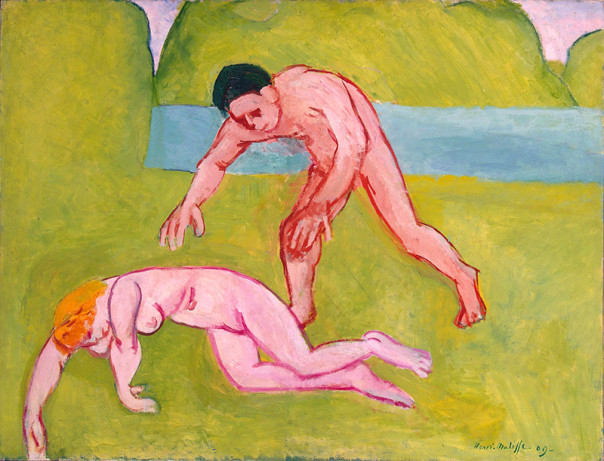
Satyr and Nymph – Henri Matisse
Work of the artist who taught me to look at colour in a different way.

Blue

You can drown in the blueness.
That’s exactly what happens, when gazing at the clear, cobalt blue sky, a human being wants to be taken up to fly with the birds.
Blue is a peace and a breath, it makes you stop, think and contemplate but may also vibrate and shine, like a lake’s still water on a fine day.
This colour, for a long time, has been associated with water and the sky. The ancient God’s, of both nature’s elements, were shown wrapped in blue coats or surrounded by clouds. The image of divine blue coat has been so deeply rooted in human mentality that, Christian symbolism transferred it on a heavenly coat of Christ the King and then on blue robes of the Holy Mother, together with white, her recognizable signs.
Sky-blue and red also have become symbols of lightning, rich harvest, marriage and happiness. At the end of the Middle Ages a strange transformation in the symbolism of this colour occurred, changing it from symbol of eternal fidelity to betrayal, faithlessness and deceit.
This change was so decisive that for some time, using blue colour in catholic liturgy was forbidden. And thus a new meaning of a blue coat in some areas appears – a symbol of disgrace and treason.
Over hundreds of years blue in many nations has become the colour of the deceased and mourning, yet not always wrapped in sorrow. The shade of Prussian blue is close to black and its often compared to shadow. Until now sometimes this is used
interchangeably blue – shadow – night – blackness.
As there is a direct link between music and colour we have references to blue. The name “blues” may have derived from American “to feel blue” which in free translation means to be melancholic. My friend, musician and writer has told me that “in jazz, there are so called “blue notes” which give sad character to the cheerful ones (simultaneously third minor and major ) and nostalgic character ( in seventh ) but also build tension and “soil” – the flatted fifth, called the devil’s interval.
…And so we come to the devil. Church could not tolerate pagan superstitions and has been their outspoken opponent, hence so old Gods, wrapped in blue coats and highly respected by people, became damned and accused of consorting with the devil. Blue, unintentionally, has become a symbol of the devil and witches.
So blue can be very ambiguous….On the one hand it has become the attribute of God, on the other – symbol of the devil and evil. Duality of human nature has been emphasized here in the magical way…

color in painting

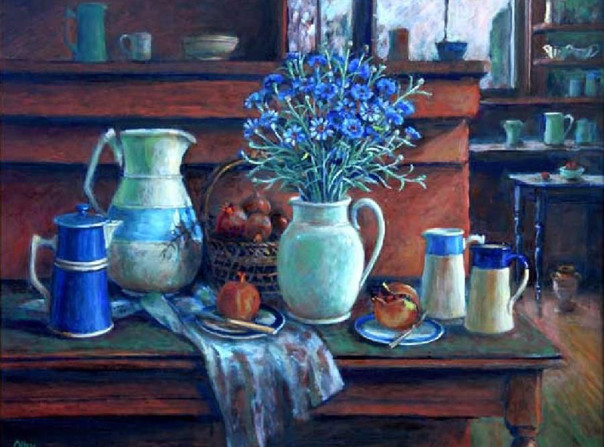
Blue Cornflowers – Margaret Olley

Work saturated with blue light, by wonderful Australian colourist.

Red

Red colour is perhaps the most controversial of all.
Its meaning in the history of mankind is marked with the biggest emotional amplitude, being perceived as warm or cool, “good” or “bad”, depending on psychosocial function and expression.
Saturated red is the shade which acts very intensely on our sympathetic nervous system. Stimulates, irritates, alerts, revives, excites.
From primeval history red has always been associated with life and death, love and hatred.
Red blood gives life. Red blood flowing out often causes death.
Life comes with vitality, strength, fertility, sex – where this colour has often been used to emphasize primary sex characteristics. For a long time red has been the colour attributed to women (as symbol of menstruation) and even prostitutes (woman associated with sex).
Furthermore, in human mentality notion of combat readiness has been added, of aggression, fighting spirit, demonstrating one’s supremacy over enemy in burning with pure red pennon on the battlefield, as well as respect, prosperity in the afterworld and getting support of the deceased in so called red burials.
There have been obviously further magical transformations when “the best” blood was coming from the most powerful animal (dragon), red circles/ribbons were to protect from all evil and scratched to blood wife’s skin was to give her deceased husband peace and happiness after crossing to the other side. And it has happened here and there that warriors were drinking blood of their courageous commanders to receive in this life-giving drink their strength and bravery or of the enemies, to raise one’s warrior prestige.
Red has been also for long time a symbol of courts, justice and inflicting punishment. Often the penalty was directly connected with blood and death hence executioner carrying out sentences wove red clothes. As he was a person held in high esteem and respect and at the same time despised and feared – it roused ambivalent feelings.
Here again red has become ambiguous. And that’s why I adore this colour.
For its aggressive vitality and ambiguity.
There is no humility in it. It simultaneously commands debauchery in life and slightly nods head accepting the unimaginable power of nature.
Light red (Saturn red) stands for fresh, joyful, still innocent eroticism. It Is like a dance of impressions still guessing wonderful profligacy of senses.
Intensive red (from) vermillion to carmine) is man’s desire. Passion which burns with amazing radiance of lust expects submission, burning and melting in rapture.
Dark red with cool shadow stands for expectation. She waits for renewed blaze, for stirring hidden longing forces. It is the redness of wine which stimulates teases, excites and sets on fire but half-opens in the density of darkness.
Red is the bridge between life and death.
Is inside me!

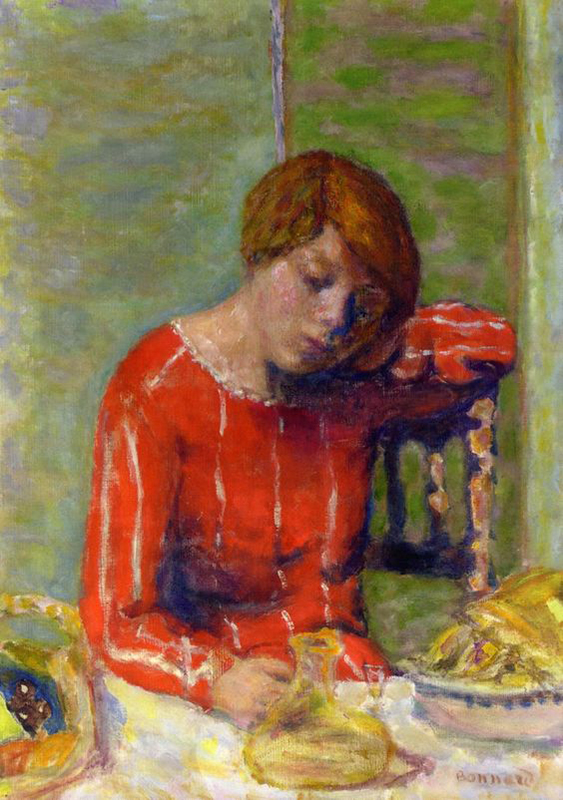
Striped Blouse - Pierre Bonnard

Striped Blouse – Pierre Bonnard

Light red as colour dominant in the work of my favourite colourist.

EnglishPoland